HIFU Device Comparison PDF Print


HIFU MYTHS: The Truth About HIFU

MYTH: A TURP (transurethral resection of the prostate) is required before every HIFU procedure.

False. A TURP is a surgical, invasive procedure that is required by physicians using the AblathermŽ but is NOT required for HIFU with the SonablateŽ 500. The reason that a TURP is not required before HIFU with the SonablateŽ is because the SonablateŽ 500 uses a 4.0cm focal length opposed to the 2.5 cm focal length of the AblathermŽ. This means that the SonablateŽ 500 can treat with HIFU at a great depth than the AblathermŽ and therefore there is no reason why patients who choose the SonablateŽ 500 would have to undergo an additional, invasive TURP, prior to HIFU.

MYTH: A TURP is required after HIFU with the SonablateŽ 500.

This is not true. The SonablateŽ 500 can treat prostates up to 40grams and does NOT require a TURP before or after the HIFU procedure. A catheter is put in place during SonablateŽ HIFU and is usually needed for 14-21 days.

MYTH: Several probe heads are needed to complete HIFU with the SonablateŽ 500 and each must be manually placed and manipulated.

False. The SonablateŽ 500 has one probe that is inserted at the beginning of HIFU. The probe has two transducers that are both located in the single probe. The transducers move independently and are controlled by SonablateŽ software once the probe is placed. More than one probe is not needed to perform HIFU with the SonablateŽ 500.

MYTH: Short focal length requires use of multiple probes to complete treatment. Probe geometry poorly configures to prostate anatomy.

False. HIFU with the SonablateŽ 500 requires one probe. Multiple probes are not required. The single, bi-plane, transrectal probe placed in the rectum under spinal anesthesia consists of two transducers allowing for treatment using two focal lengths. The two focal lengths, 3 cm and 4 cm mean that the physician and image and treat the entire prostate gland. The Ablatherm does not have the capability of treating at more than one focal length; therefore the patient is place in a position to compress the prostate abnormally in order to treat at one focal length. Additionally the SonablateŽ 500 allows the treating physician to see multiple views of the prostate including 3D images. The Ablatherm only gives the doctor one view of the prostate.

MYTH: HIFU with the SonablateŽ 500 takes 3 ˝ -5 hours.

On average SonablateŽ HIFU takes 1-3 hours with a 1-2 hour recovery period.

MYTH: The AblathermŽ is the only HIFU device certified for use in salvage therapy for patients who experience recurrence after failure of a prior radiotherapy treatment.

False. In addition to being used as a primary Prostate cancer treatment, the SonablateŽ 500 is capable of treating recurrent prostate cancer after radiation failure. In fact, it is currently being used in a FDA-approved feasibility study using HIFU to treat localized recurrent prostate cancer after external beam radiation and/or brachytherapy. The SonablateŽ 500 is also being used in a similar trial in London, Ontario in Canada for treating recurrent prostate cancer. International centers in Canada, Mexico and Japan have also used protocol developed specifically for the SonablateŽ 500 to treat radiation failures.

MYTH: The Ablatherm is the device most frequently used for HIFU treatment of prostate cancer throughout the world and was recognized by urologists as a device that perfectly complied with expectations of urologists.

There are over 150 urologists currently using the SonablateŽ 500 worldwide who believe that the SonablateŽ is a superior HIFU device than the AblathermŽ. Over 5,000 patients have been treated for prostate disease with the SonablateŽ in nearly 100 SonablateŽ HIFU Centers worldwide. Additionally, the SonablateŽ 500 is the only HIFU device available in Central or South America and Africa. The SonablateŽ 500 is the fast growing HIFU treatment for prostate cancer that is preferred by both patients and physicians because of its precision, ease of use and clinical history.

MYTH: Higher-frequency imaging results in more accurate, precise HIFU treatment and tissue ablation.

Not true. The quality of the image is in the eye of the beholder. Imaging at 4MHz gives good enough images for doctors to perform HIFU. In other words, frequency imaging higher than 4 MHz is not necessary to perform HIFU successfully. You can easily compare imaging quality in this case to your television at home. For example, the newest televisions on the market offer television in high definition, or HDTV. It might be nice to watch TV in HD, but it does not mean that you NEED to have HD in order to watch television at all.

In addition to image quality, the SonablateŽ 500 incorporates several features to enhance treatment accuracy. The SonablateŽ 500 is able to monitor blood flow through the neurovascular bundles with a color overlay during both planning and treatment. Through detecting the blood flow, physicians can clearly see the location of the neurovascular bundles (NVB), thus avoiding them to preserve potency. The AblathermŽ is not capable of monitoring neurovascular blood flow, in fact, the AblathermŽ does not have any features at all for detecting location of the NVB.

Lastly, the SonablateŽ 500 is superior because it produces a smaller, more precise lesion. Because these lesions are smaller, the physician is able to place them at the prostatic apex while monitoring the rectal wall. The AblathermŽ is only able to produce one size lesion which is 1.7 mm in diameter. It must be placed 5-8mm behind the apex; this could leave prostatic tissue outside of the treatment zone, which is undesirable and could lead to recurrence.

Unlike the SonablateŽ 500, the AblathermŽ seriously lacks important features that combine with real-time imaging to ensure precise, accurate HIFU therapy.

MYTH: Automated, power-guided controlled HIFU of the AblathermŽ is superior to Hands-on Physician Controlled Therapy of the SonablateŽ 500.

Not True. In fact, clinical experience has shown that a fixed treatment approach is NOT suitable for all patients. Research done by Mark Emberton, MD using visually-guided HIFU with the SonablateŽ 500 demonstrated that better outcomes/results were obtained if a physician monitored the entire case adjusting the power levels as needed.

Automated, power-guided controlled HIFU or fixed treatment means that the machine is programmed to give each patient the exact same HIFU therapy at set power levels. It cannot be adjusted or changed. Each HIFU case is the same.

The SonablateŽ 500 recognizes that each patient is different and therefore it is essential for the physician to be able to customize each HIFU treatment to the patient. The SonablateŽ 500 ensures physician control; it does not reply on a machine to do the work of the physician. Like with any technology, there has to be room for user interface. The SonablateŽ 500 places control in the hands of the physician, resulting in a customized treatment for each patient.

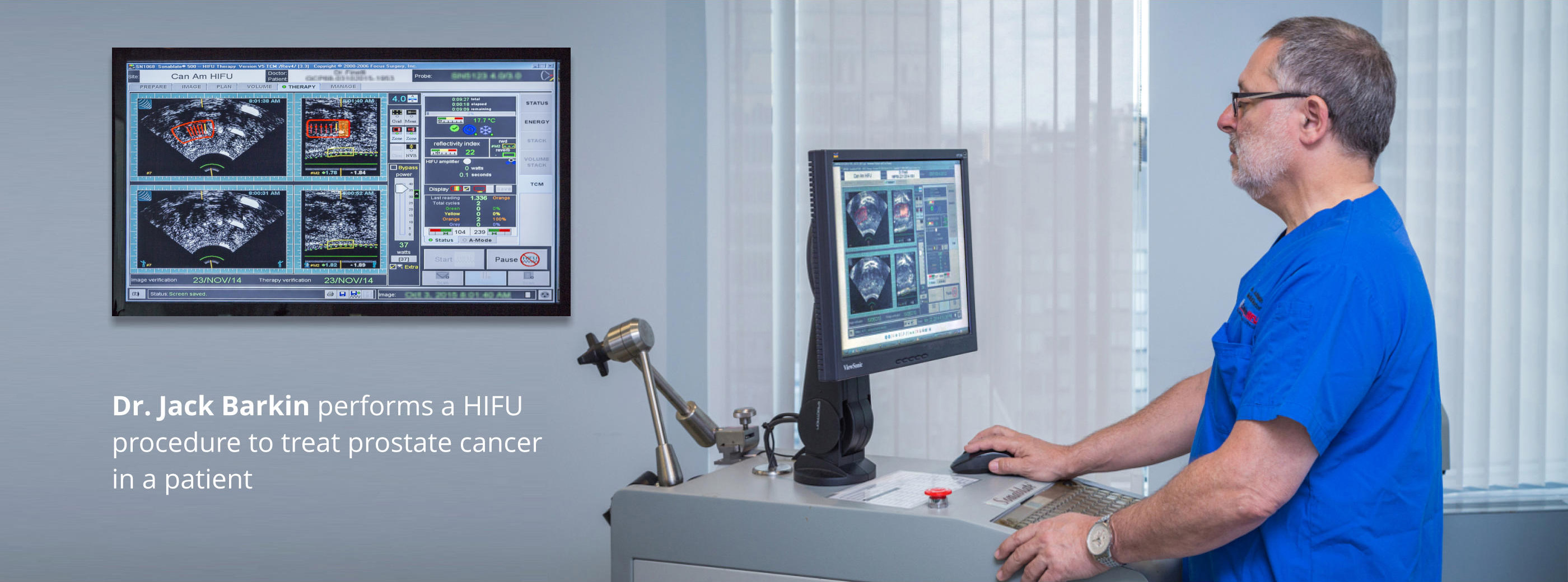
During treatment with the SonablateŽ 500, the physician actively monitors the real-time images which show treatment progression and is able to tailor the treatment dynamically by adjusting the HIFU power level and update the treatment plan to increase effectiveness and maintain safety. The Ablatherm does not have adjustable power levels.

MYTH: The SonablateŽ 500 does not have any published clinical data with men follow ups longer than one year.

The SonablateŽ has been used to treat prostate disease since the early nineties and there is a wealth of published clinical data that highlight the results of SonablateŽ users. Dr. T Uchida has recently presented and published data that showed:

Years after HIFU Biochemical Disease Free Rate 1 81% 3 77% 5 77% Biochemical Disease Free Rate After 5 Years Low Risk 97% Intermediate Risk 71% High Risk 64%

Similar data has been published and presented throughout Europe and the Americas. Clinical data includes but is not limited to:

Visually Directed HIFU for Prostate Cancer --a new standard. Rowland O. Illing**, Sam Dawkins*, Chris W. Ogden* and Mark Emberton**. *Institute of Urology and Nephrology, University College Hospital, London, UK ** The Clinical Effectiveness Unit, The Royal College of Surgeons of England, London, UK

Treatment of localized prostate cancer using high-intensity focused ultrasound. Toyoaki Uchida. Dept. of Urology University of Tokai Hachioji Hospital. British Journal of Urology International 2006.

Prostate Cancer Therapy with High-Intensity Focused Ultrasound-Comprehensive Review Thomas A. Gardner and Michael A Koch, Indiana University Medical Center, Indianapolis. Clinical Genitourinary Cancer Vol 4. No.3, 2005.

Transrectal High-Intensity Focused Ultrasound in the treatment of Localized Prostate Cancer: A Multicenter Study. Acta Urol. Jpn. 51 651-658, 2005. Toyoaki Uchida. The Dept. of Urology, Tokai University Hachioji Hospital.

High Intensity Focused Ultrasound for the Treatment of Localized Prostate Cancer. A Multi-Center Experience. George M Suarez*, Miami, FL; Rafael Estrella, Santiago De los Caballeros, Dominican Republic; Carlos Garcia, Puerto Vallarta, Mexico. Abstract from Presentation given at The 15th International Prostate cancer Conference in Vail, Colorado, February 2005

Transrectal HIFU: The Next Generation? Prostate Cancer Research Institute (PCRI) Insights. Douglas O. Chinn, MD Chinn & Chinn Urology Medical Associates, Arcadia, CA February 2005. Pages 8-15.

Clinical Outcome of HIFU for the Treatment of localized prostate cancer: 5-year Experience. Toyoaki Uchida, Hiroshi Ohkusa, Hideyuki Yamashita, Yoshihiro Nagata Department of Urology, Tokai University Hachioji Hospital. Abstract - ISTU 2004

Clinical Outcome of HIFU for Localized Prostate Cancer: 5 year Observations. Toyoaki Uchida, E. Yamashita, Y. Okusa, T. Nagata, Tokai University, Tokyo, Japan. Podium presentation given at the 2004 Japan Endourology and ESWL Conference, Okayama, Japan November, 2004.

High Intensity Focused Ultrasound for Prostate Cancer: Clinical Results and Technological Evolution John C. Rewcastle, Ph.D. Department of Radiology, University of Calgary Alberta, Canada

Quality of Life in Patients with High Intensity Focused Ultrasound (HIFU) for localized Prostate Cancer. Toyoaki Uchida, E. Yamashita, Y. Okusa, T. Nagata, Tokai University, Tokyo, Japan. Podium presentation given at the 2004 Japan Endourology and ESWL Conference, Okayama, Japan November, 2004.

Transrectal High-Intensity Focused Ultrasound for treatment of patients with Stage Tib-2N0M0 localized Prostate Cancer: A Preliminary Report. Presentation of preliminary clinical results of transrectal HIFU in stage T1b-2N0M0 prostate cancer. Dr. T Uchida, M.D.

Localized Prostate Cancer Treatment by High Intensity Focused Ultrasound (HIFU) Toyoaki Uchida M.D., Department of Urology, Kitasato University, Tokyo, Japan. The Journal of Highly Advanced Medical Technology. Highly Advanced Medical Technology Research Center, Volume 15, March 2000 (Translated from Japanese and updated with current information by Focus Surgery, Inc.)

Localized Prostate Cancer Treatment by High Intensity Focused Ultrasound (HIFU): Preliminary Results. Toyoaki Uchida M.D., Department of Urology, Kitasato University, Tokyo, Japan. This summary has been abstracted from previously published work and supplemented by additional new treatment data prepared by Dr. T. Uchida, M.D. by Focus Surgery, Inc.

Noninvasive Surgery of Prostate Tissue by High Intensity Focused Ultrasound: An Updated Report. European Journal of Ultrasound. N. T. Sanghvi 2,*, R. S. Foster1, R. Bihrle1, R. Casey3, T. Uchida4, M. H. Phillips2, J. Syrus2, and A. V. Zaitsev2 , K. W. Marich2 , F. J. Fry

MYTH: The SonablateŽ 500 does not have a warning system or safety features that alerts user of patient movement.

Wrong. The truth is that the SonablateŽ software and hardware are designed to ensure patient safety and do not rely simply on one warning system but the entire HIFU treatment is monitored to ensure there is no possible danger to the patient.

The reality is that the safety system on the Ablatherm relies solely on an inefficient infrared warning system to detect movement of the patient. This movement system is tied to the hip of the patient and not related to the treatment area. You might have movement of the monitored area that does not affect the treatment area but that will cause an alarm. Like most infrared movement detection systems on the market they prompt many false alarms. Several environmental conditions including but not limited to movement can trigger the alarm system. A common complaint from doctors that use the system is that it gives you a lot of false alarms. Each Alarm will stop the unit and require that the unit is checked for alignment, which can extend treatment time for the patient.

However, with the SonablateŽ the doctor can monitor both real-time images and references images at the same time. This means that the SonablateŽ software allows him to simultaneously compare images from the planning stage of HIFU with the real-times images during HIFU. If any movement has taken place in the treatment area, then the doctor will be able to compare the images and stop treatment. The ability to be able to view both sets of images (real-time and reference) is a superior, more accurate method for identifying real movement of the prostatic tissue within the treatment zone.

  Next: HIFU Treatment
 
RocketTheme Joomla Templates